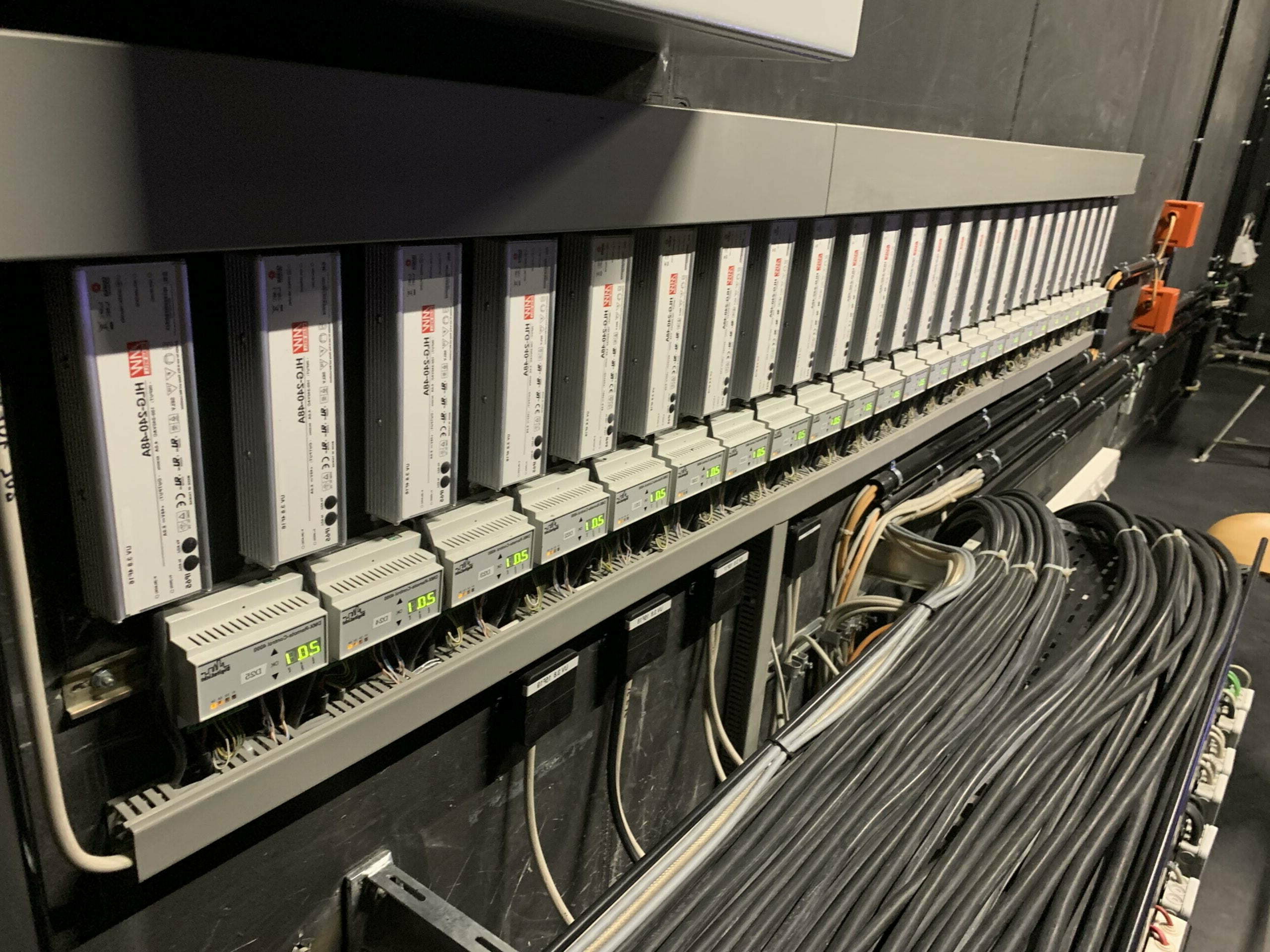
Controls for LED step lighting. From an individual power supply or LED dimmer to a complete project-specific control cabinet.
Bissinger Lights supplies the electrical system behind professional step lighting: 24 V power supplies, fine LED dimming, DMX/DALI integration and complete control cabinets – where required with an independent battery system, charger and automatic changeover.
A power supply. A dimmer.
Or the complete control system.
Choose individual components or let us configure the complete electrical package. We coordinate the technology around the actual LED step-lighting system – for new installations and existing venues.
Suitable power supply
For replacement, extension or a new installation – selected according to LED load, output voltage, circuits and supply conditions.
Useful to start: a photo of the existing nameplate or information about the connected LEDs.
Suitable LED dimmer
For precise brightness control and integration with DMX, DALI or a project-specific operating concept.
Useful to start: which LEDs are being operated and how should the brightness be controlled?
Complete control system
Power, dimming, protection and connection points assembled as one coordinated unit – from a compact enclosure to a multi-circuit control cabinet, optionally with battery backup.
Useful to start: a photo, drawing or short description of the new or existing system.
You do not need to select the electrical components yourself. Describe the task and the operating concept. We will determine which components and interfaces are required.
Complete control cabinets.
The system technology in one defined package.
You define the requirements. We prepare the control cabinet with coordinated power supplies, dimmers, protection, internal wiring and clearly identified connection points.

What can already be integrated
- Power supply
- Power supplies selected for LED load, circuit structure and the required operating reserve.
- Dimming & control
- Coordinated dimmers and interfaces for DMX, DALI or the agreed operating concept.
- Protection & terminals
- Protection, terminals and labelled outputs with clear assignment of the lighting circuits.
- Documentation
- Connection and wiring information for integration by the responsible electrical contractor.
Less improvisation during installation. The local electrical team receives defined connection points and documentation for integration, commissioning and testing.
Discuss a complete control cabinet →
Battery-backed step lighting.
When the central supply cannot cover the requirement.
A project-specific battery system can combine power supply, battery, charger and automatic changeover for the step-lighting circuits. This can be useful where the existing central battery has no available capacity, cannot be connected to the new system, or where a dedicated supply is required.
- No spare central battery capacity
- Central battery connection not available
- Dedicated supply for new or variable areas
How the dedicated battery system works
- Normal operation The power supplies operate the lighting while the charger keeps the battery ready for use.
- Loss of mains power The battery takes over automatically. Defined circuits remain illuminated at the agreed brightness – even where the external DMX or DALI signal is no longer available.
- Mains power returns The system returns to normal operation and the battery is recharged.
Runtime is calculated for the actual system. LED load, backup brightness, control consumption, conversion losses and reserve determine the required battery capacity.
Discuss battery backup →
Battery backup does not automatically constitute statutory emergency or safety lighting. Required runtime, monitoring, cable system, test requirements and life-safety functions must be coordinated with the responsible electrical and safety planning for the individual project.
Existing backup or battery supply already available? See how existing supplies can be integrated →
DMX or DALI for LED step lighting.
DMX is particularly relevant in theatres, performance spaces and event environments. DALI is often the logical interface where the step lighting forms part of a building automation system. The correct solution follows the venue and its operating concept.
Standalone operation is also possible. A project-specific local control concept can be developed where DMX or DALI is neither available nor required.
Fine dimming – especially at very low brightness.
In a dark theatre or cinema, the lower end of the dimming range matters more than maximum brightness. LED technology, dimmer and control need to work together without unstable or distracting light.
Set the right operating brightness
Step edges should remain visible at low ambient light without becoming visually dominant. The dimming range is selected around the LED system and venue.
Consider camera operation
Where recording or broadcasting is relevant, the dimmer configuration can be coordinated with the intended camera application and LED system.
Custom operating logic
Depending on the selected equipment, brightness values, operating sequences, priority functions and behaviour after signal loss can be defined before fabrication.
How does the new control system fit the existing power concept?
If a suitable backup or battery supply already exists, we review voltage, available capacity, LED load and the required behaviour during backup operation before selecting the control components.
Normal and backup operation are designed together. Supply, priority, signal loss and the required fallback state are coordinated with the responsible project planning.
Project example: existing 24 V battery supply at Kino Lichtspiele Wemding

When the battery system provides 24 V DC.
At Kino Lichtspiele Wemding, an older Tubelight installation was to be replaced with LED step lighting. The existing power arrangement could not simply be carried over unchanged; 24 V DC was available from the battery installation.
The new LED supply was therefore configured around the existing infrastructure, with LED loads and circuit structure considered as one complete system.
- Existing 24 V DC battery supply as the starting point
- Previous Tubelight supply reassessed technically
- New LED loads and circuits configured accordingly
- Existing infrastructure and new technology treated as one system
You describe the task.
We define the technical configuration.
Describe the requirement
Send a photograph, plan or short description. Missing technical information can be clarified together.
Engineering & quotation
Components, functions, interfaces and battery runtime are coordinated as required.
Supply or fabricate
Individual components are supplied or the control cabinet is assembled, labelled and functionally checked as agreed.
Support integration
The appointed electrical contractor receives the agreed connection information and technical support for integration.
Need installation support as well? Depending on project location and scope, Bissinger Lights can provide agreed installation or commissioning support, or coordinate the system for integration by the local project team. More about project integration →
Different starting points require different solutions.
These realised projects in Germany and Luxembourg demonstrate why the control system is not an accessory added at the end, but part of the complete step-lighting concept.
Tubelight converted to LED
Existing 24 V DC battery infrastructure was used as the starting point for the new LED supply and circuit concept.
Existing light lines retained. DALI added later.
Existing step and stage-edge lighting remained in place while the controls were adapted to the new building-automation interface.
Independent battery system with DMX control
Dedicated battery supply, charger and coordinated behaviour after loss of mains power or DMX. In this project, backup operation was approximately 3 to 3.5 hours.

Decentralised technology matched to the venue
Project-specific control units were configured around the existing supply conditions and custom recessed luminaires.
View project →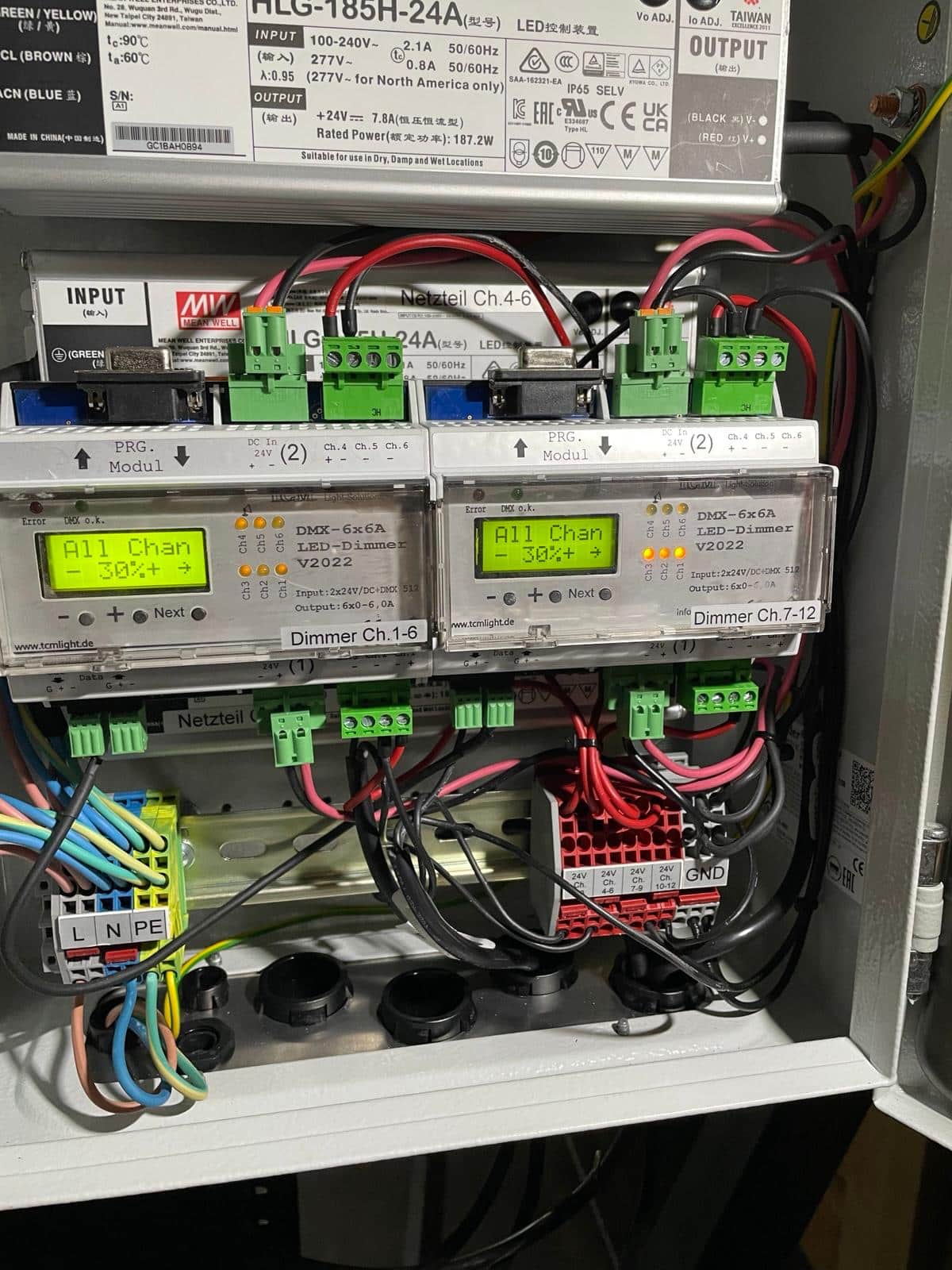
Existing infrastructure retained and later extended
Existing cabling was assessed and reused while the system remained expandable for later plug-in platform sections.
View project →
Control technology coordinated with building services
Dedicated control cabinet with separately considered lighting circuits and integration with the existing building-services concept.
Technical configuration and special cases.
If your project is already at a detailed planning stage, these sections summarise the relationships between supply, dimming, interfaces, battery operation and variable systems.
Voltage, control and dimming at a glance
How are battery, charger and backup operation sized?
DMX controller and dimmer manuals
Manuals are available for operation and commissioning of the respective device configuration. The exact equipment used in a project-specific cabinet is defined during engineering.
3-channel DMX controller · PDF → 6-channel DMX dimmer · PDF →What enclosure and cabinet configurations are possible?
The enclosure follows the system.
The important question is not how large the enclosure is, but which functions, circuits, interfaces and supply paths the project requires.
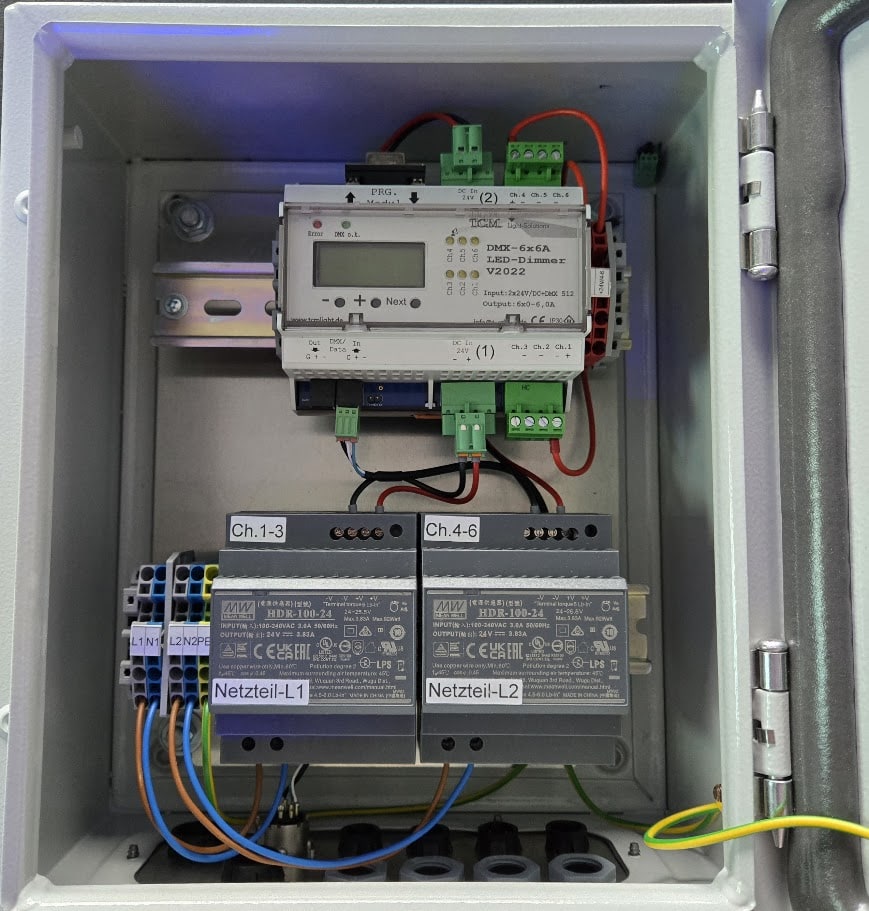
Control units for individual areas
Power supply, dimmer, protection and terminals combined for smaller or decentralised lighting circuits.
Cabinets for larger installations
Multiple power supplies, dimmers, terminals and zones arranged in a clear, maintainable system.
Defined operation during supply failure
Battery, charger, control logic and defined brightness states can be integrated where the project requires them.
Adapt the new controls to the existing supply
Existing 24 V DC battery or backup infrastructure can form the basis of the new system where technically suitable.
What do we consider when engineering the complete system?
Problems often occur between the luminaire, cable and control system.
A step-lighting system can be connected correctly and still perform poorly in real operation. We therefore consider the complete electrical path, not only the control protocol.
Retractable seating, platforms and plug-in systems
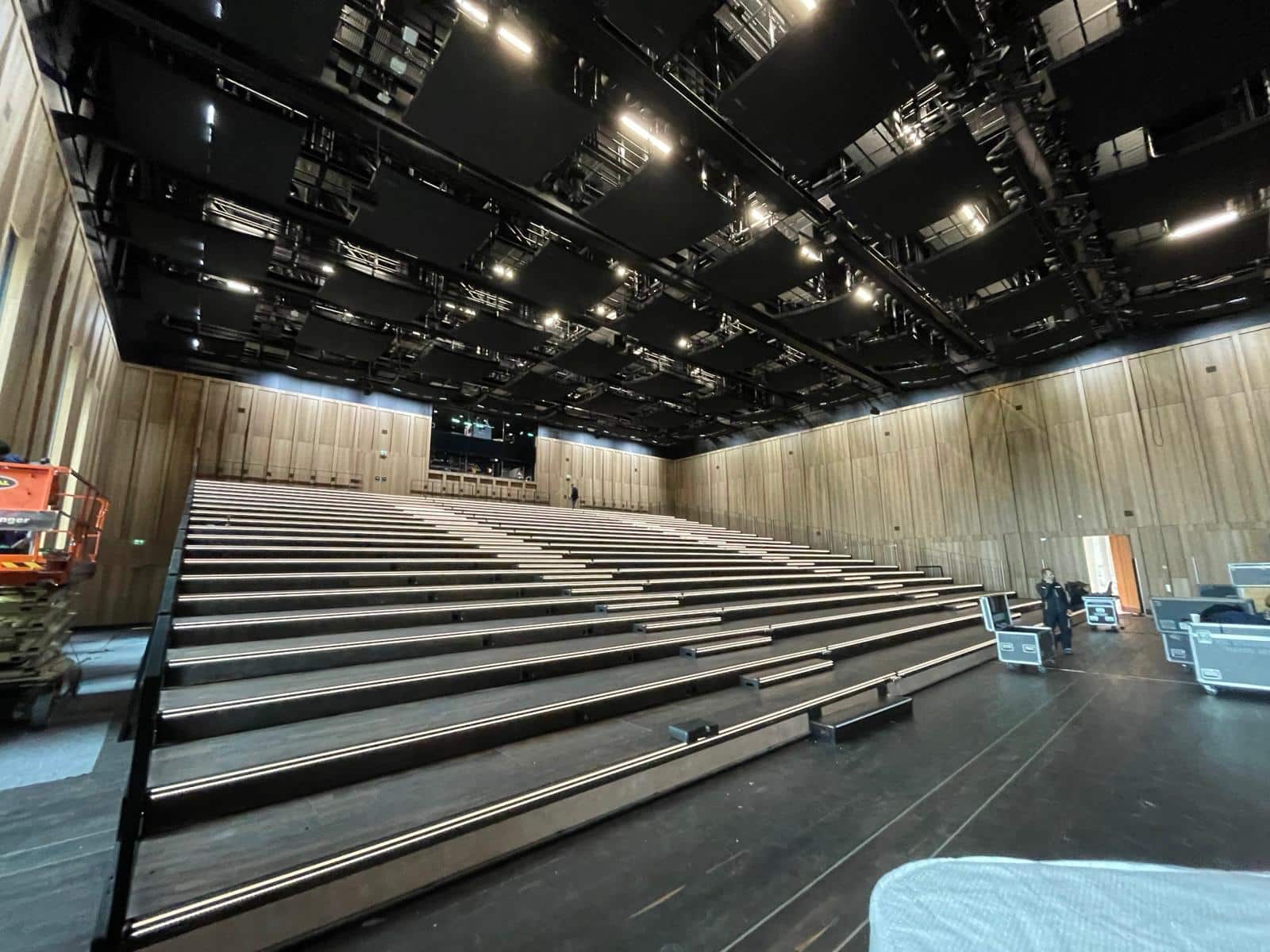
On moving structures, cabling becomes part of the control concept.
Retractable grandstands, variable platforms and removable access steps need a different electrical strategy from a fixed staircase. Power and control signals need to cope with movement, reconfiguration and repeated connection.
Common questions about LED step-lighting controls.
Can LED step lighting have its own battery system?
Yes. A project-specific control and supply unit can include its own battery, charger, power supply and automatic changeover. Runtime, backup brightness and interfaces are engineered around the actual system.
How long can the step lighting continue to operate from a battery?
Runtime is calculated for the individual installation. Relevant factors include LED load, required backup brightness, control-system consumption, losses and reserve. At Nationaltheater Mannheim, the realised project was designed for approximately 3 to 3.5 hours of backup operation; this is not a general value for other systems.
Can DALI step lighting be combined with an independent battery supply?
Yes, project by project. DALI interface, dimmer, power supply and battery changeover need to be considered as one system. The intended lighting state after loss of mains power or the external control signal is defined during engineering.
Does battery-backed step lighting automatically count as emergency lighting?
No. A battery system provides a defined backup operating state. If the step lighting is intended to form part of statutory emergency or safety lighting, monitoring, runtime, cable system, testing and local compliance requirements must be coordinated with the responsible electrical and life-safety planning.
What is included in a complete control cabinet?
Depending on scope, the cabinet can include power supplies, LED dimmers, protection, internal wiring and labelled terminals. A battery version can additionally include battery, charger and automatic changeover. The exact scope is defined in the quotation.
Can we purchase only a power supply or dimmer?
Yes. Individual power supplies and LED dimmers can be supplied as well as complete project-specific control units.
Can the dimming system be selected for camera recording?
Yes. The intended recording or broadcast environment can be considered when selecting the LED and dimmer configuration. Exact performance depends on the complete system and camera settings.
Are custom control sequences or fallback functions possible?
Depending on the selected equipment, operating sequences, brightness values, priority functions and behaviour after signal loss can be defined for the project.
Can existing 24 V DC infrastructure be reused?
Potentially yes. The existing supply, cabling, conductor sizes, routing and available capacity first need to be checked against the new LED loads and control components.
Can existing cabling be retained?
Where condition, cross-section, routing and electrical loading are suitable, existing cabling can be incorporated into the new system concept.
Is DMX or DALI better for step lighting?
Neither is universally better. DMX is particularly suited to theatre, stage and event environments. DALI is often suitable where the step lighting forms part of fixed building automation. Existing infrastructure and operation determine the appropriate interface.
Can an existing system later be converted to DALI?
Depending on the installed lighting and control technology, yes. At Humboldt University Berlin, existing step and stage-edge lighting was retained while the control system was adapted to DALI.
How are retractable grandstands or plug-in platforms controlled?
Power and control need to accommodate movement and repeated assembly. Depending on the project, plug connections, energy chains, wireless DMX or modular circuit structures may be used.
What information is useful for an initial control-system assessment?
Helpful information includes the number and length of light lines, available supply voltage, approximate cable lengths, desired dimming and the intended DMX/DALI interface. For a battery system, required runtime and backup brightness are useful where already known.
What does your step-lighting system need?
A photograph, drawing or short description is enough to start. We will identify the required power, dimming, interfaces and backup concept from there.
- Your requirement Power supply, dimmer, complete control cabinet or dedicated battery system.
- Your installation New build or existing system; photos, labels, plans or LED data if available.
- Your operating concept DMX, DALI, battery runtime, camera requirements or project schedule where already known.
Project drawings, photographs and existing-system information can be included with the enquiry.
From the light line to power and controls: view the complete LED step-lighting system.